
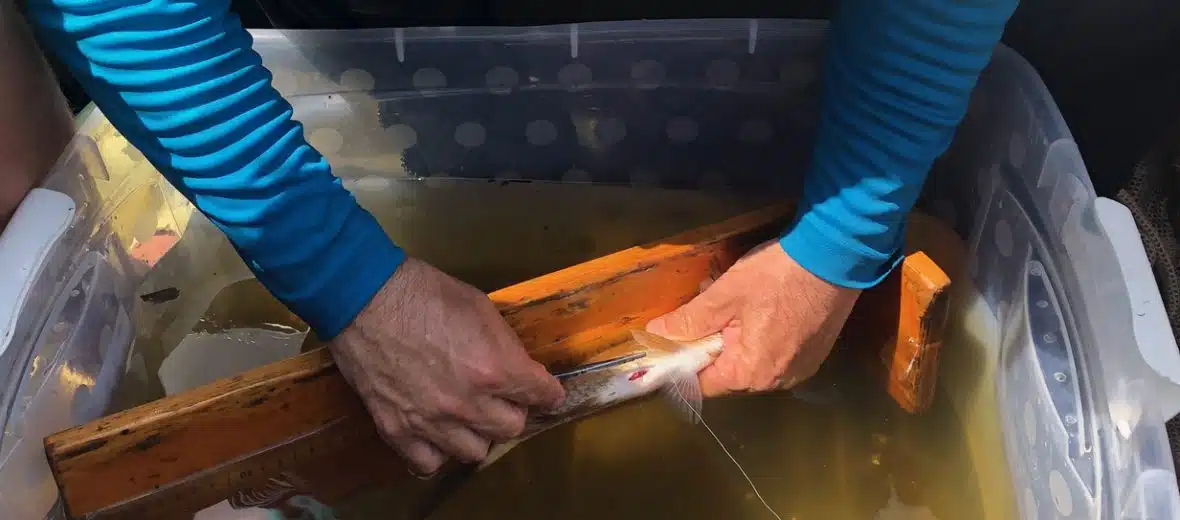
 Juvenile tarpon (Megalops atlanticus) use coastal marsh ponds, like those found in Lemon Creek Wildflower Preserve, as important nursery habitats. Such nurseries provide ample food, room for fish to grow, and allow for movement into the open estuary. However, prior to restoration of Wildflower Preserve that occurred in 2020, the habitat was found to be suboptimal for supporting tarpon. Fish seemed to be crowded and were not growing to the same sizes as those in natural habitats before leaving the safety of the ponds.
Thanks to a large grant from the National Oceanic and Atmospheric Administration (NOAA), the FWC was able to tag tarpon with acoustic transmitters to track their movements throughout the preserve. This allows FWC scientists to better assess how the fish are using the restored areas and determine if they are successfully leaving the nursery and at what size. Understanding tarpon movements in Wildflower Preserve—in conjunction with abundance and size information collected by the Lemon Bay Conservancy tarpon pull—will help to better understand the life cycle of tarpon and bring awareness to this iconic species.
 Acoustic receivers (instruments that listen for tagged fish) were placed throughout the restored ponds in March of 2025, and a total of nine tarpon have been tagged to date. Following the first periodic download of the data collected by receivers, preliminary analysis showed that three of the nine tagged tarpon successfully exited the preserve through Lemon Creek. The fish ranged in length from 18-29 inches and differed in their use of the ponds as well as the date at which they left the preserve (Figure 3). Following tag implantation, both tarpon 1 (pictured in Figure 1) and tarpon 2 remained in Pond 2 before exiting the preserve. Emigration was defined as detection of the tagged fish on receivers placed outside of the preserve, to the west of SR 775 close to where the Lemon Creek system meets Lemon Bay. The larger of the two fish (tarpon 1) emigrated on May 12th, over a month earlier than its smaller counterparts, which emigrated on June 23rd.
Tarpon 3 moved back and forth between the eastern and western side of Pond 2 and even made its way into Ponds 1 and 3 for some time. Tarpon 3 eventually exited the preserve, emigrating on the same day as tarpon 2. This information implies that the tarpon are using multiple ponds within the preserve. This is important because they appear to be using a large portion of the newly created habitat and are far less crowded than they were prior to restoration. Data from the monthly net pulls has shown that tarpon are achieving larger sizes within the preserve following restoration implying that this additional space, and presumably adequate food, have improved the condition of the nursery. The emigration of tarpon from the preserve to the open estuary at larger sizes than before gives the tarpon a greater chance of survival over the long run.
In addition to acoustic receivers, data loggers tracking water levels associated with tides, storm surge, and rain or drought events have been placed throughout Wildflower Preserve. The date tarpon 1 emigrated, May 12th, stood out in particular as being a king tide, caused by a weather system with strong southwesterly winds, which causes high tides to be even higher than normal, enabling fish of larger sizes, like tarpon 1, to swim through a mangrove forest into the estuary. These factors enabled the largest fish tagged to leave Pond 2; extraordinarily the fish even recognized to leave at the peak of that king tide. The date on which both tarpon 2 and 3 emigrated, June 23rd, was not a king tide, however it was still high enough for those smaller tarpon to exit the preserve, both roughly at the same time.
Other ponds in the preserve where tarpon are tagged will require even higher water levels to facilitate tarpon movement out of those ponds. Pond 6 in particular, which does have tagged fish in it, may require some type of storm surge from a tropical storm/hurricane for the tarpon to emigrate.
FWC will continue to monitor the six remaining tagged fish in the preserve for an additional two years. Furthermore, there are large arrays of receivers to the north near Sarasota Bay and to the south in Charlotte Harbor, where we may hear from these fish again and learn more about their travels.
