

Pond Cypress Planting at the Preserve
Leads to Wildlife Spotting: Juvenile Gators,
Cuban Treefrog, Softshell Turtle, and More
“Ohhh,” says uber-volunteer Beth McKinley. “It’s so cute.”
We’re at the Doodie Calls portable john off the parking area at Lemon Creek Wildflower Preserve.
My search for a wasp nest has led to the back of Doodie, where pushing a palm frond aside reveals Mr. Cute. Or maybe its Ms. Cute.
Dana Houkal, and the I.D. function on a smartphone, agree: Cuban Treefrog. About 2 ½ inches long and off-white pale in

Cuban Treefrog. Photo by Beth McKinley
color, it’s yet another non-native on the preserve. The University of Florida’s Dept. of Wildlife Ecology and Conservation says these treefrogs are native to Cuba, the Cayman Islands, and the Bahamas, and first showed up in Florida in the 1920s, thanks to shipping cargo containers.
Because they eat five Florida-native frogs, plus tadpoles and other small creatures, and are pests around houses, UCF has ominous words about this species, facts that I discovered later: “In Florida, the presence of this frog is NOT benign — they are quite literally eating our native species alive, adding pressure to species that are already greatly affected by habitat loss. It is for these reasons that we advocate humanely euthanizing invasive Cuban Treefrogs — help give our native wildlife a break!”
Pond Cypress Planting
Treefrog aside, Dana, Beth, my wife Sandy, and I were at the preserve to plant small bare-root pond cypress trees, obtained at 50 cents apiece from the state’s nursery as dormant plants. Beth and Dana, a retired forester, had already planted 125 of these young trees on the preserve, with a similar number to go.

Planting pond cypress. Photo by Sandy Schultz
Dana trimmed the roots before we installed the young trees in near-pond wet soil locations that Dana hopes will not get fully inundated during summer rains. Some are marked with survey tape and visible to trail walkers, but many are not. A few previously planted pond cypress can be seen on the preserve, but saltwater incursion from 2024 hurricanes killed off most from earlier plantings.
A Gator Brood
Earlier Beth and I had been looking at an alligator sunning itself on the bank of one of the ponds. We believed it was the same female that preserve manager Chad Lyman had discovered protecting a brood of young.
We looked at the well-hidden depression on a shaded bank where Chad had spied the nest. It seemed unremarkable from a distance, but a careful look through binoculars told a different story. Eight young alligators, guesstimated at 15 to 18 inches long, attentively laid there like a figurine spread. I gave the binoculars to Beth. The nest was well camouflaged and I was unable to get a decent photo from a distance with just a smartphone camera.

Alligator basking away from her brood. Photo by Ken Schultz
“They’re soooo cute,” Beth said.
Well, I guess. Chad had seen as many as twelve babies weeks earlier, so perhaps four had already become prey. Will more? According to the Florida Fish & Wildlife Commission (FWC), alligators have an average clutch size of thirty-eight, tend to their offspring for one to two years, and their eggs hatch from mid-August through early September. Were these juveniles born last summer, or the summer of 2024? How much longer will mom guard them? Will survivors stay on the preserve? Are there other gators on the preserve now with young?
Interesting questions. Speculative answers.
Softshell Turtle and Tilapia
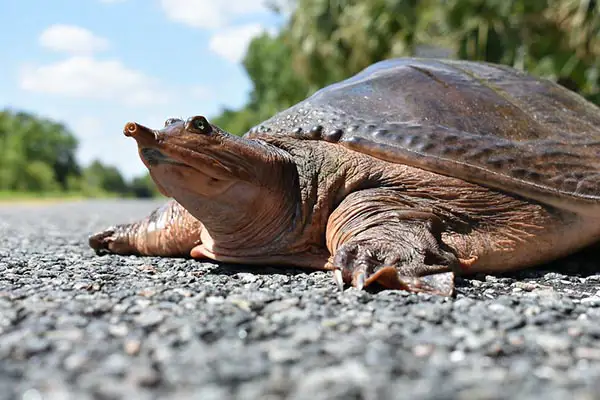
Softshell turtle. FWC photo
Moving around while planting, I saw my first close-range, on-land softshell turtle, crossing between ponds. Maybe 14 inches in length, and with a long neck observed when swimming, it moved as impressively on the land as well as in the water. Since these tube-snouted reptiles have soft shells, it seems they must be on the alligators’ food plan. Indeed, FWC says that alligators are the primary predator of adult softshells.
Fish, too, are a prime quarry of alligators, possibly the very tarpon and snook that are highly sought in the Conservancy’s monthly nettings. Tilapia are likely most favored on Wildflower Preserve ponds, if for no other reason than abundance.
The last net pull, on January 18th, produced nearly eighty fish, which included a number of snook and tarpon, nearly forty mojarra, some mullet, and several tilapia. Mojarra and tilapia are both non-natives, the former generally small, the latter commonly growing to several pounds.

Measuring a tilapia from the Jan. 18th net pull. Photo by Sandy Schultz
By April the observant preserve visitor may spot these generally light-colored fish (when seen from above) along shorelines either building large circular nests or, like the aforementioned alligator, guarding it. There are plenty of tilapia in the preserve’s ponds; most likely they’re the species known as blue tilapia. Two dinner-plate-sized specimens were caught in the last net pull, just the size that would be a good gator meal.
Speaking of eating, remember that Cuban Treefrog? We left it where it was. Who knows how many others are on the preserve? I wondered if herons or snakes or other predators would find them suitable food, but evidently irritating skin secretions preclude that.
It seems you never know what you’ll find or learn as a result of visiting Lemon Creek Wildflower Preserve. One thing’s for sure: there’s a lot more going on than first meets the eye.